Sunday, 19 January 2014

A morning walk in the sun

Cool forest on a hot day
Meetup.com has so vitally enriched my life.  One great local group is Walking, Cycling, Trips and More. Bob, who runs the show, has an incredible repertoire of walks to take people on, and I always love where he gets us to meetup.

Today he got 20 of us together in NAC, and I took the opportunity to practice my speech outside.  I wasn't on duty, but I got to lead everybody out of the Village Centre (yes, we left the building!), over to STEP, up to the Himalayan Cedars, and all the way down to the Cork Oak.

It was a grand day to be taking out so many people who were visiting NAC for the first time - after a week over 40C the morning didn't punish us too terribly, and we made it back for an ice-cream in the late morning with no stroke victims or anything.

Sunday, 12 January 2014

Vollie Day 05: Tours around the Village Centre

Today was my second guiding shift.  Of course I overslept and missed my start by enough time for the other dude on duty to take the first group out on his own.  I was punished with visitor count duty until my turn came up, which was a good chance to practice whatever I thought I might say.  

My first group was a friendly little quartet: two lovely young ladies visiting from Brisbane and Sweden (FYI I asked if they had trees in Sweden, and she said yes they do), and a polite local couple, all of whom were visiting NAC for the first time, so I kicked things off with a warning that I'll probably just make everything up and my fellow guide, who I'd asked to follow me around and give me some feedback, would sort things out. 

He showed me right up on the next tour - we took about twenty people around and I was impressed with how exactly the same material sounds completely different when being presented by somebody else.  He is enthusiastic, knowledgeable and knows how to control a crowd.  
Somewhere in this frame is where I left my dignity
Fortunately for me, a NAC crowd is a very forgiving audience. I left him at his last stop early to go and pick up my second group, but I didn't get any takers.  I set a start time for the next tour, coffeed, tried to befriend the magpies, and went back to the meeting point to discover a 25-person tour group all to myself.  I took a deep breath and plunged in. 

So here's my new formula (warning: contains spoilers)
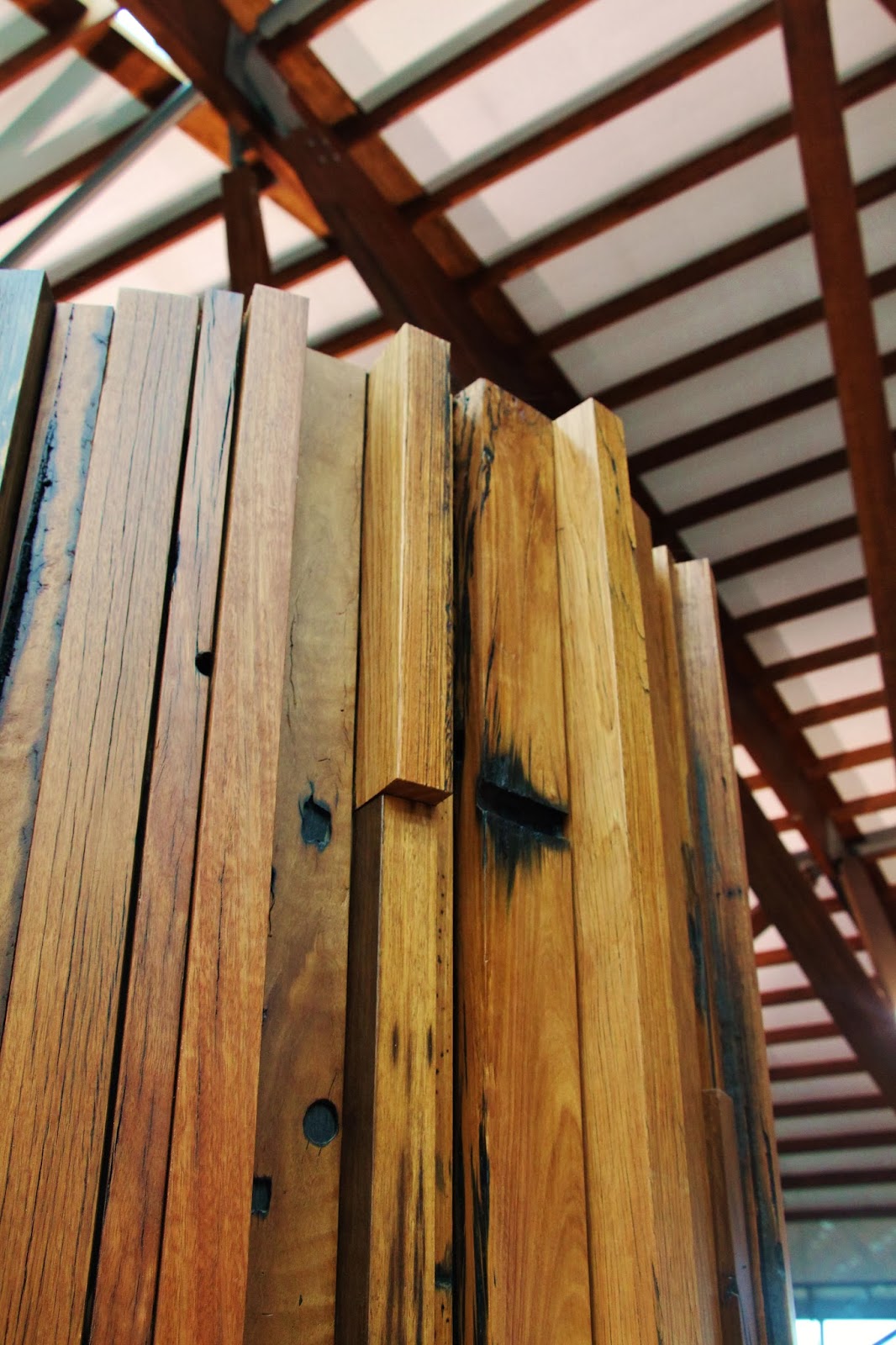
  • A potted history of NAC at the starting point, and a little about the architectural features of the Village Centre building. 
  • A short trip to the interactive map near the meeting point gives more people time to catch up with us if they decide to join us late, and a chance to demonstrate that there are parts of NAC that we can't see from the Village Centre (most of it).  It's also a good place to start talking about fire planning.
  • Out on the north deck, I can supplement some information about the conservation and research value of NAC with some general highlights like the two mature forests, the events terrace, the Wide Brown Land Sculpture, the ceremonial plantings, STEP and the Pod Playground (today I learned to do so either in that order or the reverse order so that I am keeping their eyes and bodies moving in only one direction).  If nobody's eyes are glazing over I talk about soil and more about fire prevention.  
  • The south deck is a great place to talk about water, because the 37Ml dam is right below, and it's possible to point at the massive earthworks and reveal that there are some nice big tanks underneath them.  The amphitheatre and the Margaret Whitlam Pavilion are unmissable features, and I do my best to encourage people to get up to the top of Dairy Farmers Hill to see the best view in NAC.  Some people want to know about a couple of success stories we've already had.  Everybody is interested in either the ACTEW AGL Canberra Discovery Garden because they're local and it's good to know what works in a Canberra garden, or the Bonsai collection because, well, they like trees.  If I'm lucky, the local magpie family sings me all the way through the south deck speech. 
New things I learned today:
  • That NAC is funded by ACT Government - it's a local project, not a federal project. 
  • Yeah I need to learn about the Buchan Blue, STEP, and the Camden White Gum. 

Saturday, 7 December 2013

Vollie Day 04: My first guided tours

Yes that was a long break: there was a work project to wrap up and an overseas wedding to crash, and then I had to finish my guide training (kind of) but now, yes, it's done, and I'm allowed to start guiding, and that happened today.

I picked a roster with Lori, a lovely fellow guide with whom I'd completed training.  Lori is a walking Wikipedia entry on NAC: she took our first tour for the morning and I finally understood how grossly underprepared I was to take a guided group: but I instantly learned a lot about keeping the group entertained and having a basic structure prepared before just dragging a few strangers around the building.
Thoughtful design is entertaining, but...
I took the second tour and Lori came along to back me up, which was great.  My first tour group was just one gorgeous little family who were visiting NAC for the first time on their daughter's birthday, so everything I said was going to be new information.  I decided to keep things moving quickly to try to match the energy of their kids, and to focus on things that they could take the kids to that day, like the pod playground, and to encourage them to get out into a forest on their own where the kids could go bananas in a safe and shady spot.  They were a great audience as I gave them a very brief basic history of the establishment of NAC, the rationale behind the choice of the species that were planted, some basics about water, fire and soil management, and where to go today to have some fun with the kids.

There are people who know how to make these
Lori and I had a coffee and Lori took the third tour - once again comprehensively sharing her passion for NAC, and then I took my second group: all adults this time, some of whom had come from a wedding in the Margaret Whitlam pavilion where a drone had circled the site bearing a GoPro camera whose pictures I would LOVE to see.  We focussed mostly on landscaping ideas for a family who have just taken on a large property and came to NAC to get some inspiration on how they could develop it.

I've decided to stick to a basic outline and over the coming months fill it with different factoids most relevant to the tour group audience: but also to aim to keep it under twenty minutes (and be ready to keep it under fifteen if the group is a bit restless).  This blog will build as I treat it as my study notes for both the forests (whose earlier blog entries I will actually post as I collect photos and information about them), and also for background on the site and how it is and will be managed.

So here is my list of things to remember for my next few tours as I build my repertoire:

  • From the starting point:
    A brief history: the fires and the centennial project,
    Some Village Centre architectural features.
  • To the north deck via the interactive table map:
    Landscape Design: the species chosen, their layout, and fire prevention and management,
    Any two forests within view: start with the caged Dragons, the cherries and the Sequoia,
    The Wide Brown Land sculpture,
    Get out of the Village Centre and see it: How to walk or drive to the Himalayan Cedars and the Cork Oak (two mature forests),
    For people with kids: The Pod Playground
    For people interested in landscaping and planting locally: Forest 20 (STEP), and soil management.
  • To the south deck through the Village Centre:
    Dairy Farmers Hill: the Nest II sculpture, and water management,
    Events at the auditorium and the Margaret Whitlam Pavilion,
    The Japanese Black Pine Niwaki,
    The National Bonsai and Penjing Collection of Australia
    The ACTEW Water Canberra Discovery Garden
    Still to come: gardens and covered plantings. 

Things I'll need to remember for next time:
  • Manage the pace 
  • Maintain eye contact
  • Give clear directions between stops
  • Know what's flowering this week


Tuesday, 22 October 2013

Vollie Day 03 - Planting in forests 88 and 61

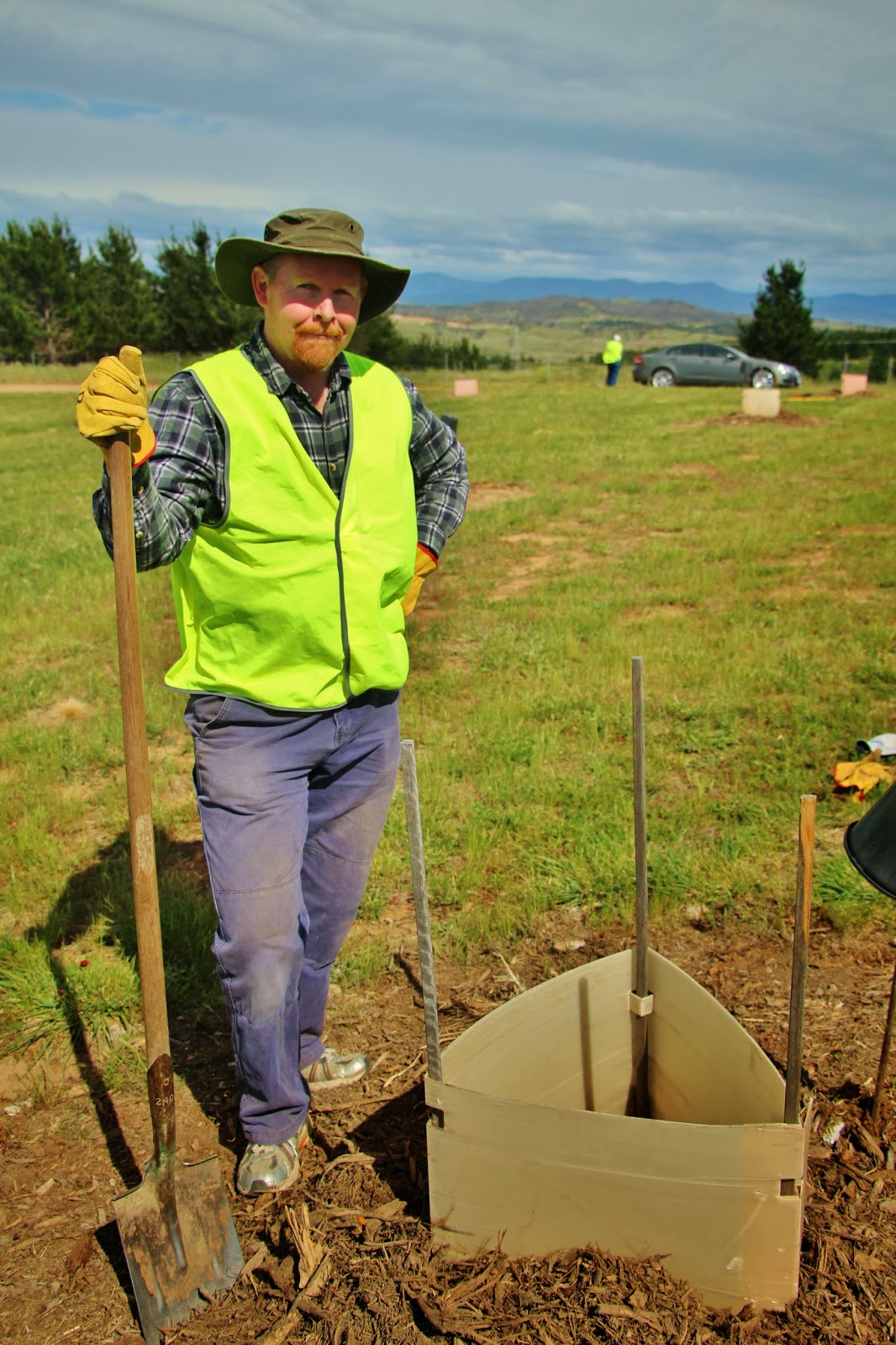
Friends of NAC can join in on volunteer activities that have a lasting legacy: replacement planting.  Most of the planting is complete, but there are the occasional casualties, and trees that didn't make it are eventually replaced.  Today, Mr Naps and I joined the Friends for some planting in Forest 88 - Juglans regia (the Persian walnut) and Forest 61 - Pinus brutia (the Turkish pine).
One tree each?  Nice.

Planting is fun, easy, rewarding and it generally doesn't take very long. When we showed up to see half a dozen cars and what looked like only a couple of dozen trees on the tray, we knew it would be a short morning.


Shovelers are highly valued at NAC
It's a team effort

We started in Forest 88 for the replacement of about a dozen Persian walnut.  Our TAMS staffies placed some potted baby walnuts by the stakes that had marked the passing of their older siblings for replacement, and gave us a brief demo.  Mr Naps was pleased to learn that the technique that his mother had passed on a generation ago was legit (dig the hole square so that the roots are less likely to take the path of least resistance and choke themselves into a tight circle as they grow).  We picked a tree or two each and had at them.

Within thirty minutes we were all looking close to finished, and when the wind picked up and a young man was nearly kited down to the parliamentary triangle on a tree guard, our next activity was diverted to the sheltered side of Dairy Farmers Hill: replanting one Turkish pine each in Forest 61.

Cue to "Battle Without Honor or Humanity" by Tomoyasu Hotei at 0:19 
Forest 61 is at the top of Dairy Farmers Hill, which has a picturesque view across Lake Burley Griffin and is on the sheltered side: so, unlike anybody who had ventured up to the lookout, we had a cosy spot.  We waited in the weeds for the delivery of a crowbar as the soil was unbreakable with shovels.
Worth it:
Forest 61 has a fantastic view
The team eventually each fought their own way through the topsoil in spite of the hurricane that was picking up, and another dozen lone pines were seated in the arboretum.
These two little dudes will grow up together

Forest 88 - Juglans regia - Persian Walnut

Other common names:
Common walnut, English walnut

Date Planted:  August 2010: and the site of a replanting on a October 2013 volunteering day I attended.
You can do that
Origin of the species name:
Juglans is Latin for the species,
regia from Latin meaning regal or of kings.

Family:  Juglandaceae
Nut much to them just yet though

Height 20m Spread 20m

Natural Distribution:
The species is native to a region stretching from the Balkans eastward to the Himalayas and southwest China.

Natural Habitat:
It usually grows at higher altitudes in deciduous forests and tends to occur either in higher rainfall areas or in moister sites in lower rainfall areas.
Also here
General Description: 
A snugly-seated babe
It is a medium-sized deciduous tree that commonly has a short trunk and has a crown that is as broad as it is high.  The bark is light, ashy grey, with flattened ridges, developing a striking diamond shaped pattern. The leaves are pinnate and the male flowers are catkins.  The fruit is a green, semi-fleshy husk and a brown corrugated nut.

Conservation Status: 
It is a species that is considered rare.  Because of its scattered natural distribution and the limited extension of the individual populations (in many situations only a few trees) it has been included in the European Forest Genetic Resources Programme.

Uses:
It is a very valuable orchard tree for the commercial production of nuts.  The nuts are consumed fresh, roasted, or salted and are used in confectioneries, pastries and for flavouring.  The leaves have also been used as an insect repellent and a tea.  Young fruits have been used as pickles and for fish poison.  Walnuts have also been used in an extremely wide range of traditional medicines, from the treating of cancer to worms.
Future medic tent site
http://www.nationalarboretum.act.gov.au/__data/assets/word_doc/0009/394479/Tree_Descriptions_November_2012.doc

Forest 61 - Pinus brutia - Turkish Pine

Other common names:
Calabrian pine, East Mediterranean pine
Turkish: kizilcam

Date Planted: November 2010, and the site of a replanting day, October 2013

Origin of the species name:
Pinus is the classical Latin for pine.
brutia is probably derived from Brutium, now Calabria, in southern Italy.

Family: Pinaceae

Natural Distribution:
The species is primarily native to Turkey and far East Greece and to the Crimea, Caucasus coast, Azerbaijan, Iraq, Syria, Lebanon, Crete and Cyprus.

Natural Habitat:
It forms pure stands or is part of coniferous and deciduous drought tolerant forests.  They grow from sea level up to 1500m, with mild, moist winters and hot dry summers.

General Description:
It is a medium-size evergreen tree.  The bark is orange-red, thick and deeply fissured at the base of the trunk, and thin and flaky up higher. The needles are up to 18 cm long, bright to dark green.  The cones are stout, heavy and hard.

Height 25m Spread 15m

Conservation Status:
It has been classified as being not threatened by the International Union for Conservation of Nature (1998) but it is now felt that this needs a reappraisal.
Okay the strawberry clover just.... kind of works

Uses:
The Turkish Pine has special significance.  It was a prominent landmark tree at the ANZAC battle site at Gallipoli, Turkey.  Cones from this and the closely related species, Pinus halepensis, were brought back to Australia, and plants grown from the seeds have been planted at numerous memorials.  It is also the most valued forest tree in the north-eastern Mediterranean area. It was planted at the NAC for its historical and iconic status in Australia and New Zealand.

The ABC wrote it up well here.

Saturday, 12 October 2013

Forest 44 - Betula pendula sp. pendula & Betula pendula sp. fontqueri - Silver Birch & Spanish Birch

Forest 44 is right on the cutting made for the parkway (bottom left)
The Friends of the National Arboretum Canberra run training for potential NAC guides.  During the training each guide prepares two short presentations.  Forest 44 was one of mine, as it is planted right at the parkway, and I'd been driving past it every day for long enough to become curious about it.

Forest 44 demonstrates particular methods of forest management and preservation: it is a mixed forest, planted with Silver Birch (Betula pendula subspecies pendula) and Spanish Birch (Betula pendula subspecies fontqueri).

Date Planted:  August 2008

Origin of the species name: 
Betula is the Latin name for the genus and is derived from the ancient Gaul word for ‘pitch’ which refers to the bituminous content of the bark,
pendula is Latin for hanging and refers to the drooping growth habit,
fontqueri is named after the Spanish botanist Puis Font i Quer.

Family:  Betulaceae

Height 25m Spread 10m

Natural Occurrence:
Silver Birch (the subspecies pendula) occurs naturally in almost all countries of Europe from the Mediterranean to Scandinavia (it is the national tree of Finland).  Spanish Birch (subspecies fontqueri) is rare and is native to three mountain systems in Spain and the Rif Mountains in Morocco.

Natural Habitat:
Silver Birch is most abundant in northern Europe, in almost continuous mixed forests and in fairly large pure stands.  In the western and southern parts of the range it is patchy and in the south silver birch is found mostly at higher altitudes.  Spanish Birch is found in small populations in dry woodlands in three mountain systems in Spain and the Rif Mountains in Morocco.

Spanish Birch: Young, and in focus
Silver Birch: Green and kind of blurry


General Description:  
Spring 2013
Both are a medium sized deciduous tree.  The bark of the young trees is grey, smooth and shiny and then goes white.  The serrated triangular leaves give a bright yellow autumn display.  The flowers are wind-pollinated catkins which come out before the leaves in early spring and produce small winged seeds.  The subspecies have different seed characteristics.

Conservation Status:
Silver Birch (subspecies pendula) is not classified as a threatened species.  Spanish Birch (subspecies fontqueri) is classified as endangered.  The subpopulations are small and dispersed and the spread of housing developments, as well as decline in water availability, fires, cutting and tourism, pose serious threats. A reintroduction program is being developed at Cordoba Botanic Garden, Spain.

Forest 44:
The Silver Birch is planted around the outside of the forest.  The seeds used for the Spanish Birch specimens grown here were collected from around Granada.  They are planted in the middle of forest 44, surrounded by the Silver Birch for protection.

The original cluster of Spanish Birch
Hola
They are wind pollinated, so the host forest of Silver Birch on the outside contaminates the seed of the Spanish Birch, but in time, after all the Silver Birch have been replaced, the Spanish Birch seeds produced will have the correct genetic make-up.  In the meantime, new Spanish Birch can be grown from cuttings from the original population planted here.  They will eventually replace all of the Silver Birch - you can already see where alternate trees in the northern rows of the Silver Birch have been removed and replaced with Spanish Birch.

Uses:
Silver Birch is grown for timber and pulp in Europe, and is a popular landscaping tree in southern Australia. They are suitable as a canopy tree or a secondary in the garden, doing well in acid soils.  The sap can be tapped (4 – 7 litres in a day) – it makes a pleasant drink and it can be fermented into a beer. The bark was used to make baskets and shoes and as an alternative to paper, and the inner bark was used as a ‘famine food’ where other forms of starch were unavailable.  The leaves can be used to make a tea that has a diuretic effect.

Further reading: